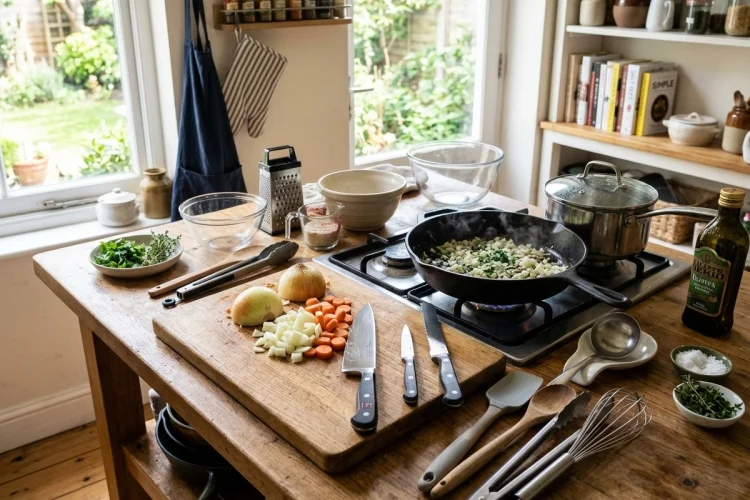
A kitchen store can make cooking look far more complicated than it really is. One aisle is filled with avocado slicers, another has twelve types of whisks, and somewhere nearby is an appliance that promises to perform twenty jobs while taking up half your counter.
The truth is much simpler. Most everyday meals can be prepared with a small collection of reliable, multipurpose equipment. The essential kitchen tools every home cook needs are not necessarily the most expensive or impressive ones.
They are the tools you will reach for when chopping onions, frying eggs, simmering soup, roasting vegetables, or reheating yesterday’s dinner. Building a practical kitchen is about choosing usefulness over novelty.
A sharp knife is more valuable than a drawer full of single-purpose gadgets, while one dependable frying pan can handle dozens of recipes.
This guide covers the basic cooking utensils, cookware, preparation tools, and safety equipment worth owning. Whether you are setting up your first apartment or simplifying an overcrowded kitchen, these essentials will make everyday cooking easier, faster, and more enjoyable.
1. Start with a Good Chef’s Knife and Cutting Board
A Versatile Chef’s Knife
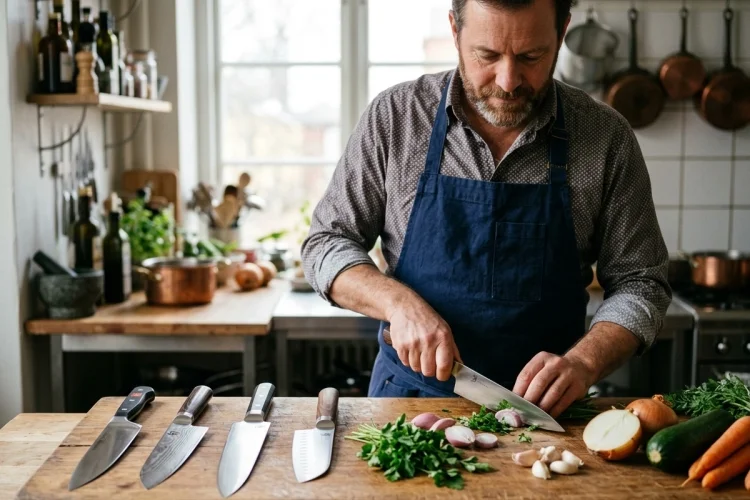
A chef’s knife is probably the most frequently used tool in a home kitchen. Its wide blade can chop onions, slice meat, mince herbs, crush garlic, and cut large vegetables.
An eight-inch knife is a practical starting size for most adults. However, comfort matters more than following a strict measurement. Hold several knives when possible and choose one that feels balanced rather than unnecessarily heavy.
The Culinary Institute of America notes that the shape and length of a chef’s knife provide leverage when cutting larger ingredients. A properly sharp blade also allows cleaner, more controlled slicing.
You do not need an expensive professional knife. A reasonably priced model with a comfortable handle can perform extremely well when it is regularly sharpened.
A Stable Cutting Board
Choose a cutting board that provides enough room to work without ingredients constantly falling over the edges. Wood and sturdy plastic are both practical options for everyday preparation.
Place a damp kitchen towel underneath the board if it slides on the counter. A stable surface helps you work more confidently and reduces the risk of accidents.
Many home cooks keep separate boards for raw meat and ready-to-eat ingredients. At a minimum, wash the board thoroughly with hot, soapy water between different food-preparation tasks.
2. Choose Multipurpose Pots and Pans
A Reliable Frying Pan
A medium or large skillet can handle eggs, pancakes, vegetables, fish, chicken, sauces, and one-pan dinners. For many households, a 10- or 12-inch pan offers enough cooking space without becoming difficult to lift.
Nonstick pans are helpful for delicate ingredients such as eggs and fish. Stainless steel is excellent for browning and creating pan sauces, while cast iron holds heat well and can move from the stovetop to the oven.
There is no single perfect material for every situation. Choose the option that matches the food you cook most often, and learn how to control its temperature.
A Medium Saucepan
A saucepan is useful for cooking rice, boiling eggs, reheating soup, preparing oatmeal, and making sauces. A capacity of roughly two to three quarts is suitable for many everyday jobs.
Look for a pan with a secure handle and a well-fitting lid. The lid helps water boil faster, controls evaporation, and allows foods to cook more gently.
A Large Pot or Dutch Oven
A larger pot becomes valuable when preparing pasta, stock, chili, curry, or meals for several people. A Dutch oven is particularly versatile because it works for stovetop cooking, braising, deep frying, and oven baking.
You do not need a complete cookware set immediately. Start with a frying pan, saucepan, and larger pot, then add specialty pieces only when your cooking habits justify them.
3. Add a Few Hardworking Cooking Utensils
A wooden spoon or heat-resistant silicone spoon is essential for stirring sauces, soups, and stews. Silicone is especially useful because it can scrape the corners of a pan without damaging nonstick surfaces.
A flexible spatula makes flipping eggs and pancakes easier, while a firmer turner works well for burgers and roasted vegetables. Choose utensils rated for high temperatures so they do not warp or melt.
Kitchen tongs are another surprisingly useful tool. They can turn meat, toss pasta, serve salad, move roasted vegetables, and retrieve food from hot oil or boiling water.
Finally, keep a ladle for soup and a slotted spoon for lifting ingredients while leaving liquid behind. These basic kitchen utensils cover far more tasks than a collection of highly specialized gadgets.
4. Make Preparation Easier with Mixing and Measuring Tools
Mixing Bowls
A set of nesting mixing bowls is useful for combining ingredients, marinating meat, tossing salads, and holding chopped produce. Stainless steel bowls are lightweight and durable, while glass bowls allow you to see the mixture clearly.
Choose bowls in several sizes. A small bowl is convenient for sauces and seasonings, while a larger one gives you enough space to mix without spilling food across the counter.
Measuring Cups and Spoons
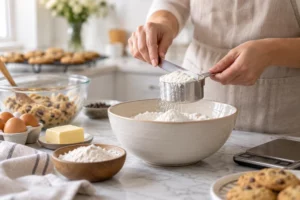
Measuring spoons are useful even for experienced cooks, especially when working with strong spices, baking soda, or concentrated flavorings. Separate measuring cups for dry and liquid ingredients can also make recipes easier to follow.
For casual cooking, small differences rarely ruin a meal. Baking, however, depends more heavily on accurate ratios.
A Digital Kitchen Scale
A compact kitchen scale is one of the most useful tools for anyone who bakes regularly.
Measuring ingredients by weight can be more accurate, create fewer dirty dishes, and make it easier to divide or resize recipes. King Arthur Baking considers a digital scale an essential baking tool.
It is also useful outside baking. You can portion meat, divide dough evenly, measure coffee, or track how much of an ingredient remains.
5. Keep Essential Oven Tools on Hand
A rimmed baking sheet is useful for far more than cookies. It can roast vegetables, cook chicken pieces, toast nuts, bake fish, reheat pizza, and support a complete sheet-pan dinner.
Serious Eats recommends simple aluminum sheet pans because they can handle high oven temperatures and are not easily ruined by scratches from metal utensils.
A rectangular baking dish is another versatile addition. Use it for casseroles, baked pasta, roasted meat, brownies, and layered desserts.
You will also need oven mitts that properly cover your hands and wrists. Thin kitchen towels may work in an emergency, but they can slip or become dangerously hot when damp.
A wire cooling rack is helpful for baked goods, but it can also improve air circulation around roasted or fried food. Place it inside a rimmed tray to keep food elevated above oil or cooking juices.
6. Use Tools That Improve Safety and Consistency
An Instant-Read Thermometer
A food thermometer removes much of the guesswork from cooking meat. Color and texture alone do not always show whether food has reached a safe internal temperature.
The USDA recommends using a food thermometer to check both safety and doneness. It should be inserted into the thickest part of the food without touching bone, fat, or the cooking pan.
An instant-read model is useful for chicken, steak, bread, sauces, frying oil, and reheated leftovers. It can prevent both undercooking and the common habit of cooking meat until it becomes dry.
A Colander and Fine-Mesh Strainer
A colander makes draining pasta, washing vegetables, and rinsing beans easier. Choose one with a stable base so it does not tip over in the sink.
A fine-mesh strainer handles smaller tasks, including rinsing rice, dusting desserts, straining sauces, and removing seeds from liquids. These two tools may look similar, but their different hole sizes make both useful.
7. Buy for Your Cooking Habits, Not Trends
Not every home cook needs a stand mixer, food processor, air fryer, wok, or blender. These appliances can be valuable, but only when they support meals you genuinely prepare.
For example, an immersion blender may be a smart purchase if you regularly make smooth soups, sauces, or purées. Serious Eats highlights it as a space-saving alternative to a large countertop blender.
Before buying a new gadget, ask how often you will use it and whether an existing tool can perform the same job.
Equipment that serves several purposes usually offers better value and creates less clutter. Professional bakers also often prefer versatile tools that can handle jobs beyond one specific recipe.
Quality matters most for tools used every day. Spend more on a comfortable knife, durable pan, or accurate thermometer before investing in decorative accessories or trendy appliances.
The essential kitchen tools every home cook needs are simple, dependable, and versatile. Begin with a chef’s knife, cutting board, frying pan, saucepan, large pot, mixing bowls, basic utensils, and measuring equipment.
Add a baking sheet, thermometer, colander, and other tools as your skills develop. There is no reason to build a perfect kitchen overnight. Start with equipment that supports the dishes you already enjoy, then notice which tasks feel unnecessarily difficult.
Open your cupboards this week and identify the tools you use most often. Replace anything unsafe or unreliable, remove gadgets that create clutter, and choose one practical essential that will make your next meal easier to prepare.