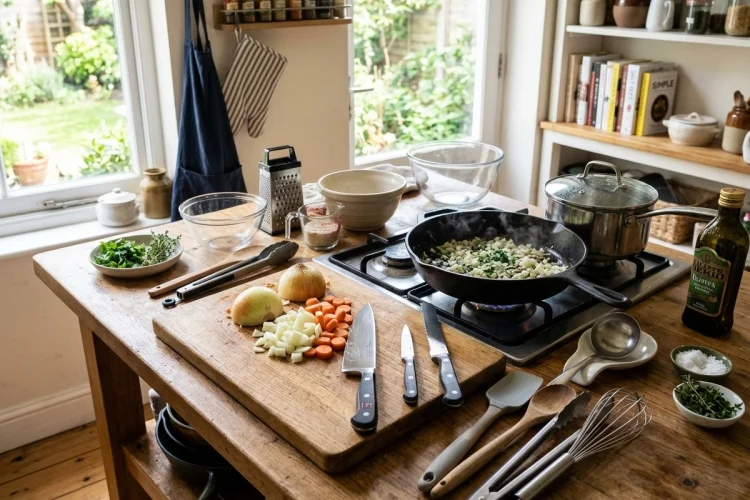

A chef’s knife is probably the tool you will use most often in the kitchen. It can slice onions, chop herbs, portion meat, crush garlic, and handle most everyday food preparation. That versatility is also why buying one can feel surprisingly complicated.
Knife shops offer different lengths, blade shapes, steel types, handles, weights, and price points. Some models feel solid and powerful, while others are thin, light, and highly precise. Neither style is automatically better.
Learning how to choose the right chef’s knife is less about finding the most expensive blade and more about choosing one that suits your hands, cutting technique, and cooking habits.
This guide explains the features that genuinely matter, the labels you should not overvalue, and the practical tests that can help you find a dependable everyday knife.
1. Begin with a Practical Blade Length
Chef’s knives come in several sizes, although blades between eight and ten inches are especially common. A six-inch knife feels compact, while a ten-inch model provides more leverage and cutting length for large ingredients.
For most home cooks, an eight-inch chef’s knife is a sensible starting point. It is long enough for cabbage, melon, and meat but remains manageable when chopping garlic or herbs.
Your workspace matters too. A long blade can feel awkward on a small cutting board, while a short knife may require extra strokes when preparing large vegetables. Choose a size you can guide confidently without straining your wrist.
2. Match the Blade Shape to Your Technique
Western-Style Chef’s Knives
Many Western chef’s knives have a curved belly and pointed tip. The curve supports a rocking motion, where the tip stays near the board while the heel moves up and down.
These knives often feel sturdy and work well for repeated chopping or cutting dense produce.
Japanese-Style Chef’s Knives
Japanese-style knives, including many gyutos and santokus, often have straighter edges. They suit push-cutting and controlled up-and-down chopping rather than exaggerated rocking.
Their thinner blades can pass through vegetables with little resistance. However, some fine edges are less forgiving if you twist the blade, strike bone, or cut frozen food.
Choose a curved profile if you naturally rock the knife. A flatter edge will probably feel better if you prefer push cuts.
3. Choose a Steel You Can Realistically Maintain
Stainless steel resists rust and staining better than traditional carbon steel, making it a practical choice for beginners and busy households. It still needs to be washed and dried after use, especially after cutting acidic ingredients.
Carbon steel can take a very sharp edge and often sharpens easily. It gradually develops a dark patina, but it may rust or discolor when left wet. Stainless-clad carbon knives reduce the exposed carbon-steel area and therefore some of the maintenance.
Harder steel generally keeps a fine edge longer but can be more vulnerable to chipping. Slightly softer steel usually needs sharpening more frequently, yet it is often tougher and more forgiving.
Do not choose a knife based only on a steel name or hardness number. Blade geometry, heat treatment, and manufacturing quality also influence real-world performance.
4. Test the Handle, Weight, and Balance
A knife can look perfect online and still feel uncomfortable in your hand. Handle shape, texture, total weight, and weight distribution affect control during repetitive preparation. Trying several models in person is useful because the right knife should feel natural rather than tiring.
Some cooks prefer a heavier German-style knife because it feels stable and powerful. Others enjoy a lighter Japanese blade that moves quickly and causes less fatigue during detailed cutting.
Try a pinch grip by lightly holding the blade near the handle with your thumb and index finger, then wrapping the remaining fingers around the handle. This widely taught grip can improve balance and control.
Check for pressure points around your palm and fingers. The handle should not feel slippery, overly thick, too short, or uncomfortable after a few chopping movements.
5. Look Beyond Forged, Stamped, and Full-Tang Labels
Forged knives are shaped from heated steel and are often heavier, thicker, and more expensive. Stamped knives are cut from sheets of steel and tend to be lighter and more affordable.
However, forged does not automatically mean excellent, and stamped does not mean weak. Modern manufacturing can produce high-quality examples of both. Heat treatment, blade geometry, comfort, and quality control matter more than one manufacturing label.
A full tang means the steel extends through the handle. It can contribute to strength and balance, but it does not guarantee that the knife will cut well or feel comfortable.
Treat these terms as background information. Your hand and cutting test should have the final say.
6. Check Performance, Care Requirements, and Price
When a shop allows demonstrations, test the knife on an onion, carrot, potato, or herb. It should enter the food cleanly without excessive pressure, track predictably, and avoid wedging badly in dense ingredients.
Sharpness in the shop is only the beginning. Almost any new blade can feel impressive. More important is whether the design remains comfortable, suits your technique, and can be sharpened easily.
Every knife eventually becomes dull. Honing can help realign an edge, while sharpening removes metal to create a fresh one. Many kitchen knives are maintained at roughly 15 to 20 degrees per side, although the manufacturer’s recommendation should take priority.
Wash the knife by hand, dry it promptly, and store it in a sheath, block, drawer insert, or magnetic holder. Use wood or suitable plastic cutting boards rather than glass, stone, or ceramic surfaces, which can damage the edge.
You do not need to spend hundreds of dollars. Leave room in your budget for a proper board and sharpening method. A moderately priced knife that fits your hand and stays sharp is more valuable than a luxury blade you rarely use.
Knowing how to choose the right chef’s knife comes down to fit, function, and maintenance. Begin with a practical length, decide whether a curved or straighter blade suits your cutting motion, and select a steel that matches the care you are willing to provide.
Then focus on handle comfort, weight, balance, and control. Do not let words such as forged, stamped, or full tang make the decision for you.
Visit a store when possible, hold several knives, and test a few basic chopping movements. Choose the model that feels secure and natural-not simply the one with the highest price. Keep it clean and sharp, and it can become your most dependable kitchen tool.