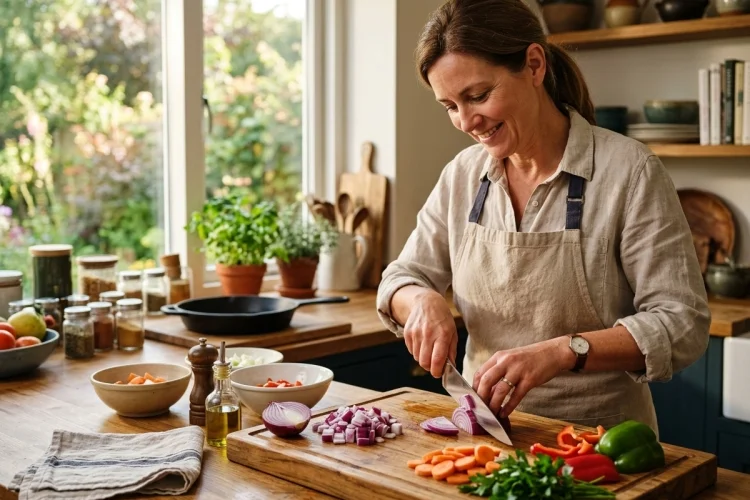
A good knife can make cooking feel quicker, calmer, and far more enjoyable. However, owning a sharp chef’s knife is only half the story. You also need to know how to hold it, guide it, and move it safely through different ingredients.
Fortunately, developing basic knife skills every home cook should master does not require professional culinary training.
A few simple techniques can help you chop onions more evenly, slice vegetables with better control, and prepare ingredients without constantly worrying about your fingers. Good knife work is not mainly about speed.
It is about stability, consistency, and using the correct motion for the food in front of you. Speed usually develops naturally once your movements become comfortable.
In this guide, you will learn how to set up a safe cutting area, hold a knife correctly, protect your guiding hand, and perform the most useful everyday cuts.
You will also discover practical exercises for building confidence without turning dinner preparation into a stressful cooking exam.
1. Set Up a Safe Cutting Station
Before picking up your knife, make sure your workspace is stable. Use a cutting board that is large enough to hold both the ingredient and the food you have already cut.
A board that slides across the counter is dangerous and frustrating. Place a damp kitchen towel or non-slip mat underneath it to keep it steady.
Round ingredients such as onions, potatoes, and carrots can roll while you cut them. Create a flat surface first by slicing a small section from one side, then place that flat side against the board.
Good Food recommends stabilizing ingredients this way and keeping the guiding fingers curled away from the blade.
Keep the area around your board reasonably clear. Bowls, packaging, and unused utensils can interrupt your movement or hide the knife when you put it down.
2. Learn the Pinch Grip
Many beginners hold a chef’s knife by wrapping every finger around the handle. This feels natural, but it may offer less control over the blade.
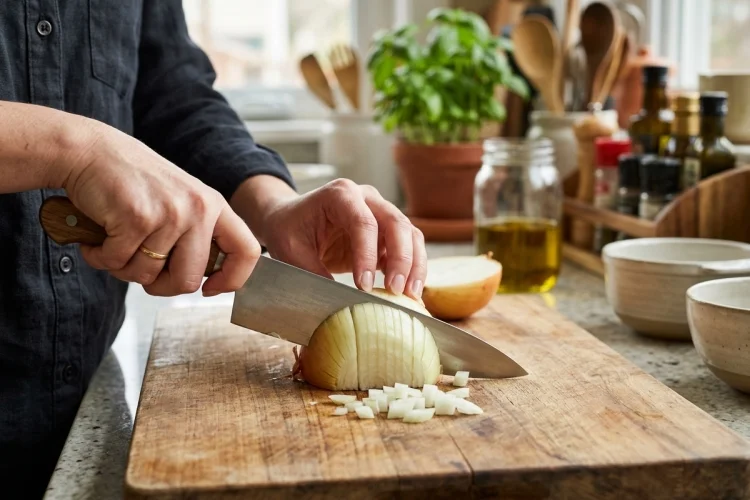
For a pinch grip, place your thumb on one side of the blade and your index finger on the other, just in front of the handle. Wrap your remaining three fingers comfortably around the handle.
You are not pinching the sharpened edge. You are holding the flat sides of the blade near the heel, where it meets the handle.
This position brings your hand closer to the knife’s center of balance. Serious Eats explains that a blade grip generally provides better balance and precision than holding only the handle.
Keep your wrist relaxed and aligned with your forearm. Gripping too tightly can make your hand tired and your movements stiff. The knife should feel controlled, not trapped in a clenched fist.
3. Protect Your Fingers with the Claw Technique
Your non-knife hand is often called the guiding hand. Its job is to hold the ingredient steady and help control the size of each cut.
Curl the fingertips of this hand inward to form a loose claw. Keep your thumb tucked behind your fingers rather than allowing it to stick out beside the ingredient.
The flat part of your knuckles can gently touch the side of the knife blade. As you cut, move the guiding hand backward a little at a time.
Do not raise the blade unnecessarily high. Keeping it relatively close to the board gives you more control and reduces the chance of hitting your fingertips.
The claw grip may feel strange at first, so practice slowly with a large, stable vegetable such as a potato or zucchini. Both culinary-school and practical cooking guides teach the claw as a foundational technique for protecting the fingers while guiding the blade.
4. Master the Three Main Knife Motions
Rock Chopping
Rock chopping works well with curved chef’s knives. Keep the tip of the blade close to the board while lifting and lowering the heel in a smooth rocking movement.
This technique is useful for chopping herbs and mincing garlic. Avoid pushing your free hand down on the sharpened edge while rocking the knife.
Push Cutting
In a push cut, the knife moves forward and downward through the ingredient. Lift it slightly, bring it back, and repeat.
This motion works particularly well for vegetables. It creates clean cuts without aggressively striking the board.
Slicing
Slicing uses a longer forward or backward movement rather than pressing straight down. Let the sharp edge travel through the food instead of forcing it with your body weight.
Use slicing motions for meat, tomatoes, cooked chicken, and other delicate ingredients. A knife is designed to cut through movement, so excessive downward pressure is usually a sign that the blade is dull or the technique needs adjusting.
5. Practice the Essential Everyday Cuts
Chopping
Chopping means cutting food into pieces without requiring perfectly uniform shapes. It works well for herbs, nuts, cooked meat, and vegetables going into rustic soups or stews.
Although the pieces do not need to look identical, try to keep them reasonably similar in size.
Slicing
Slicing creates thin or thick flat pieces. Cucumbers, mushrooms, onions, and meat are commonly sliced.
Choose the thickness before starting and use your guiding hand to maintain it. Slow, deliberate cuts are more useful than fast, uneven ones.
Dicing
Dicing produces small cube-like pieces. Begin by cutting the ingredient into flat sections, then strips, and finally cubes.
Small dice are useful for salsa, sauces, and fast-cooking dishes. Larger dice work well in roasted vegetables and stews.
Mincing
Mincing means cutting an ingredient into very small pieces. Garlic, ginger, chilies, and fresh herbs are often minced so their flavor spreads throughout a dish.
A rocking motion can help reduce the pieces further. Escoffier describes mincing as a fine cut commonly created by keeping the knife tip near the board and moving the heel through the ingredient.
6. Focus on Consistency Before Speed
Professional chefs often appear to cut at incredible speed, but copying that pace is not a sensible goal for a beginner. Work slowly enough to stay in control.
Uniform cuts are valuable because pieces of similar size tend to cook at approximately the same rate. If half your carrots are thin coins and the rest are large chunks, some may become soft before the others are ready.
Culinary training resources emphasize consistency because even cuts support more predictable cooking and presentation.
A practical exercise is to cut one potato into slices of equal thickness. Stack a few slices, turn them into matching sticks, and then cut those sticks into cubes.
Do not worry about creating perfect restaurant-style shapes. Compare the pieces, notice the differences, and try again during your next meal.
Speed will arrive through repetition and muscle memory. Rushing before you have control simply teaches your hands to repeat inconsistent movements faster.
7. Keep Your Knife Sharp, Clean, and Properly Stored
A dull knife can require extra force and may slip when it meets a tough skin or uneven surface. A sharp edge usually moves through food with less pressure and greater predictability.
Honing and sharpening are related but different. Honing helps maintain or realign an existing edge, while sharpening removes a small amount of metal to create a fresh edge.
Wash kitchen knives individually rather than dropping them into a sink full of soapy water. A hidden blade can easily cut someone reaching into the sink.
Clean the blade with the sharp edge facing away from your hand, then dry it immediately. Avoid putting quality knives in the dishwasher, where heat, detergent, and movement can damage the edge and handle.
Store knives in a block, protective sheath, drawer insert, or suitable magnetic strip. Never leave a sharp knife loose in a drawer.
When moving around the kitchen, hold the knife by the handle with the blade pointed downward and close to your side. Never attempt to catch a falling knife-step back and let it land.
Basic knife skills can make everyday cooking safer, faster, and much less frustrating. Begin with a stable cutting board, learn the pinch grip, and protect your guiding hand with the claw technique.
Then practice chopping, slicing, dicing, and mincing with slow, controlled movements. Remember that consistency matters more than speed.
Evenly cut ingredients cook more predictably, while a sharp, properly maintained knife gives you better control. Choose one inexpensive vegetable, such as a potato, carrot, or zucchini, and spend ten minutes practicing this week.
Focus on your grip and the size of each piece. Repeat the exercise regularly, and confident knife work will gradually become a natural part of your cooking routine.