Few kitchen tasks are as common-or as strangely intimidating-as cutting an onion. It rolls around, falls apart into slippery layers, and may leave your eyes watering before you have finished half of it.
The good news is that learning how to dice an onion safely and evenly is easier than it looks. You do not need lightning-fast chef skills or complicated knife movements.
You simply need a stable cutting board, a reasonably sharp knife, a safe hand position, and a method that keeps the onion under control. Evenly diced onions are not just prettier.
Pieces of a similar size cook at roughly the same rate, helping you avoid a pan filled with both burnt edges and undercooked chunks. Consistent cuts also make sauces, soups, curries, salads, and salsas feel more balanced.
This guide walks you through a beginner-friendly technique that avoids awkward horizontal cuts. Take it slowly, focus on control rather than speed, and onion preparation will soon become one of the easiest parts of making dinner.
1. Understand Why an Even Dice Matters
Dicing means cutting an ingredient into small, cube-like pieces. Unlike rough chopping, the goal is to keep those pieces reasonably consistent in size and shape.
Uniform onions cook more evenly because similarly sized pieces soften and brown at approximately the same speed. Irregular chunks can create frustrating results: tiny pieces may burn while larger ones remain sharp and crunchy.
The ideal size depends on the recipe. Finely diced onions blend easily into sauces, dressings, and fillings. Medium pieces work well in soups, curries, and sautés, while a larger dice suits rustic stews and roasted dishes.
Perfect cubes are unnecessary for everyday cooking. Aim for general consistency rather than turning dinner preparation into a geometry lesson.
2. Choose the Right Knife and Prepare Your Workspace
A standard chef’s knife is usually the best tool for dicing an onion. Its long blade can move through the entire vegetable cleanly, while its width gives you space to guide it with your knuckles.
Make sure the blade is sharp enough to slice without excessive pressure. A blunt knife can slide across the onion’s smooth surface, crush its layers, and encourage you to push harder than necessary.
Use a cutting board large enough to hold the whole onion, the finished dice, and your knife. Place a damp kitchen towel or non-slip mat underneath the board if it moves across the counter.
Professional knife-safety guidance recommends securing the board and organizing the work area before cutting begins.
Keep your hands and knife handle dry. Clear away packaging, bowls, and utensils that might restrict your movement.
3. Prepare the Onion Without Losing Stability
Place the onion on its side and identify its two ends. The stem end usually has a pointed or papery tip, while the root end has small, dry fibers.
Trim a thin slice from the stem end, but leave the root attached. The root helps hold the onion’s layers together during most of the cutting process.
Stand the onion on its newly flattened end. Cut straight down through the center of the root so you have two equal halves.
Place each half flat-side down and remove the papery skin. Peel away any tough, dry, or damaged outer layer, but avoid removing more edible onion than necessary.
The flat side gives you a stable base, preventing the onion from rolling. Keeping the root intact also makes the layers easier to control until the final cuts.
4. Use a Safe Grip Before Making Any Cuts
Hold the knife with your dominant hand. For greater control, lightly pinch the blade near the handle with your thumb and index finger, then wrap your remaining fingers around the handle.
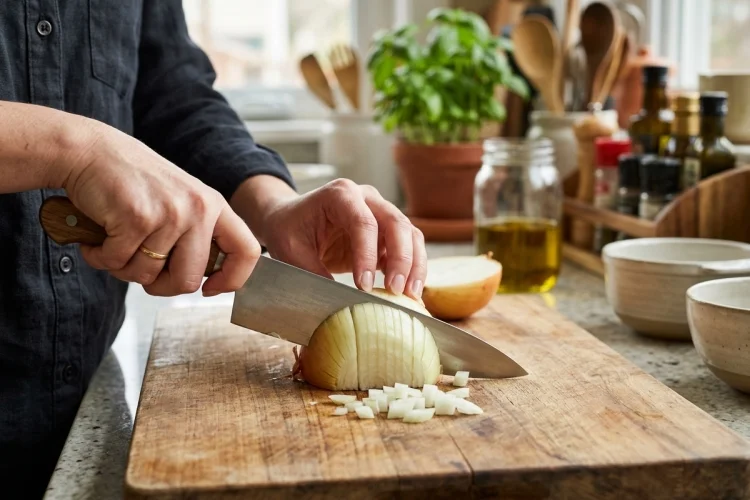
Your other hand should form a loose claw. Curl your fingertips inward, tuck your thumb behind them, and allow the flat side of the blade to rest gently against your knuckles.
Move the claw backward gradually as you cut. Your knuckles guide the blade while your fingertips remain away from the cutting edge.
Do not rush this position. Practice forming the claw with the knife resting safely on the board before you begin. A proper pinch grip and steady guiding hand are fundamental parts of professional knife-safety training.
5. Follow This Beginner-Friendly Dicing Method
The traditional method often includes horizontal cuts made with the knife parallel to the cutting board. Although experienced cooks may use that technique successfully, it places the blade close to the hand holding a slippery onion.
A safer alternative divides the onion into quarters and uses only downward cuts. It produces an even dice without requiring you to push the blade horizontally toward your guiding hand.
Step 1: Make the First Vertical Cuts
Place one onion half flat-side down with the root pointing away from you. Make a series of evenly spaced downward cuts running from the stem side toward the root.
Stop just before cutting through the root. The spacing between these cuts will help determine the final size of the pieces.
Step 2: Divide the Half into Quarters
Extend the center cut completely through the onion half so it separates into two quarters. Each piece should still remain connected at the root end.
You now have two smaller pieces with additional flat surfaces. These are easier and safer to control than a rounded onion half.
Step 3: Rotate the Quarters
Turn each quarter onto its newly cut flat side. The first set of cuts should now appear to run sideways through the onion.
Line up the two quarters if you feel comfortable cutting them together. Beginners may find it easier to work with one piece at a time.
Step 4: Make a Second Set of Cuts
Make another series of evenly spaced downward cuts from the stem side toward the root. Once again, stop before cutting completely through the root.
These cuts cross the onion’s natural layers and the first set of slices, creating the structure needed for cubes.
Step 5: Cut Across to Create the Dice
Rotate the onion piece and begin cutting across it, starting at the stem end. Use a smooth forward-and-down slicing motion while your claw hand guides the thickness.
Small cubes will fall away with each stroke. Continue toward the root, then stop when the remaining piece becomes too small to hold safely.
Turn the root-end piece onto a stable side and carefully trim any usable onion from around it. Discard the tough root itself or save clean trimmings for stock.
6. Control the Size of Your Onion Dice
The distance between your cuts determines the size of the finished pieces. Wider spacing creates larger cubes, while narrow spacing produces a finer dice.
In professional terminology, a small dice is approximately ¼ inch, a medium dice is around ½ inch, and a large dice is roughly ¾ inch. These measurements are useful targets, but home cooks do not need to measure every cut with a ruler.
Use a small dice for salsa, meatballs, omelets, dressings, and smooth sauces. Smaller pieces soften quickly and distribute onion flavor throughout the dish.
A medium dice is practical for curries, casseroles, soups, and everyday sautéing. Larger pieces hold their shape better in hearty stews and roasted vegetable mixtures.
Focus on repeating the same spacing. Consistency matters more than whether your pieces match an exact culinary-school measurement.
7. Avoid Common Mistakes and Reduce Onion Tears
One common mistake is cutting the root off too early. Without it, the layers separate and become harder to hold together.
Another is pressing straight down with force instead of slicing smoothly. Let the sharp edge travel slightly forward as it moves downward. This creates a cleaner cut and requires less pressure.
Do not chase speed. Fast cutting looks impressive, but control, hand position, and even spacing are more important. Speed develops naturally through repetition.
Onions make your eyes water because cutting their cells releases compounds that eventually form an airborne irritant called syn-propanethial-S-oxide. When it reaches your eyes, the tear glands respond to the irritation.
A sharp knife can help because it cuts more cleanly instead of crushing as many cells. Good ventilation may also move the irritating vapors away from your face. Try working near an extractor fan or placing a small fan beside the cutting area.
Once diced, use the onion immediately or refrigerate it in a sealed container. The strong aroma can spread to other foods, so avoid leaving chopped onions uncovered in the refrigerator.
Learning how to dice an onion safely and evenly comes down to preparation, stability, and controlled movements. Use a sharp chef’s knife, secure your cutting board, keep the root attached, and protect your fingers with a claw grip.
For a beginner-friendly approach, quarter the onion and make two sets of downward cuts before slicing across to create cubes. This avoids the awkward horizontal movement used in the traditional method.
Do not worry about working quickly or creating flawless restaurant-style pieces. Concentrate on safe hand placement and consistent spacing.
Practice the technique the next time a recipe calls for onion, compare the size of your pieces, and make small improvements. After a few onions, the entire process will feel quicker, calmer, and far more natural.