Have you ever followed a cake recipe, only to pull something dry, dense, or strangely flat from the oven? The recipe may not be the problem.
A little too much flour, an oversized spoonful of baking soda, or an inaccurate liquid measurement can change the result more than most beginners expect.
Cooking often leaves room to improvise. You can add stock to a soup or adjust a sauce before serving. Baking is different because its ingredients begin reacting before the finished structure appears.
Flour absorbs liquid, gluten develops, fat adds tenderness, sugar manages moisture, and leaveners produce the gas that helps batter and dough rise.
Understanding why baking requires accurate measurements makes the process less mysterious. You do not need laboratory precision, but you do need dependable ratios, suitable tools, and a consistent method.
With those habits, cakes rise more evenly, cookies spread more predictably, and bread becomes easier to repeat.
1. Baking Depends on Balanced Ratios
A baking recipe is a formula. Flour provides structure, liquid hydrates the mixture, fat adds tenderness, sugar affects moisture and browning, and eggs help bind and enrich the finished bake.
Changing one ingredient alters its relationship with everything else. Extra flour does not simply create more cake; it lowers the relative amounts of liquid, sugar, fat, and leavener, often producing a dry or heavy texture.
Bread bakers use baker’s percentages, treating total flour weight as 100% and calculating other ingredients against it. This makes hydration and recipe scaling easier to control.
2. Flour Is Easy to Mismeasure
Scooping flour directly from a bag can compress it inside the cup, giving you more than the recipe intended. Too much flour can make cakes crumbly, muffins heavy, cookies dry, and bread dough stiff.
King Arthur Baking standardizes one cup of its all-purpose flour at 120 grams and recommends weighing it for consistent results.
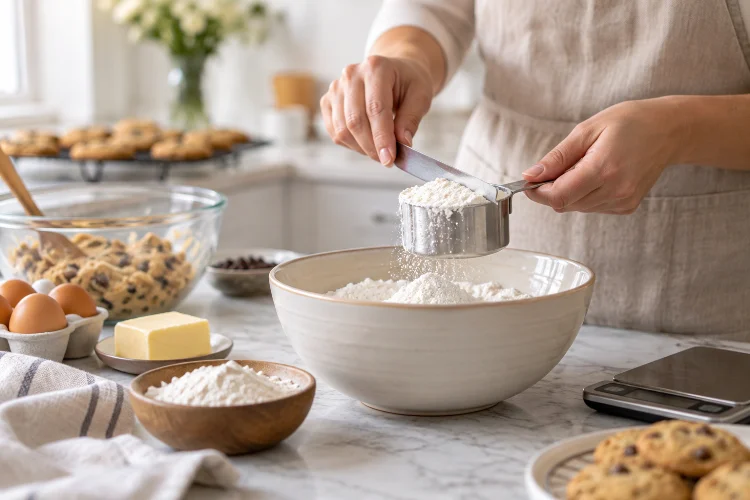
Use gram measurements when provided. Without a scale, loosen the flour, spoon it into a dry measuring cup, and level the top without packing it down.
Apply the recipe’s stated method to cocoa, powdered sugar, and other dry ingredients as well. Some ingredients settle or become compacted during storage, so casually scooping them may produce inconsistent quantities.
3. Liquids, Sugar, and Fat Control Moisture
Liquids hydrate flour and help dissolve sugar, salt, and other ingredients. Too little liquid can leave a mixture stiff and dry, while too much may weaken its structure or extend the baking time.
Measure water, milk, and oil in a liquid measuring cup placed on a flat surface. Read the measurement at eye level rather than holding the cup in the air, where tilting can make the reading inaccurate.
Sugar does more than add sweetness. It affects moisture, browning, tenderness, and how much cookies spread. Reducing it significantly may therefore change the texture and shape of a recipe, even when the finished product is still sweet enough.
Fat also influences texture and flavor. Butter, oil, and shortening are not automatically interchangeable in equal quantities. Ingredient substitutions can alter the color, volume, flavor, or texture of baked goods.
4. Small Leavener Errors Have Large Effects
Baking powder and baking soda create gas that helps cakes, muffins, cookies, and quick breads expand. Because recipes use them in small quantities, an extra half teaspoon can represent a major percentage error.
Too little leavener may create a dense, low bake. Too much can make batter rise rapidly and then collapse, while also leaving a bitter or chemical aftertaste.
Baking soda needs an acidic ingredient to react properly. Baking powder already contains both acidic and basic components, so the two products cannot usually be substituted in equal amounts.
Use standard measuring spoons, fill them evenly, and level the surface. This is also important for salt, which can strongly affect flavor and control yeast activity in bread dough.
Check the freshness of your leaveners as well. Even perfectly measured baking powder or baking soda may perform poorly after losing strength during long storage.
5. Eggs and Tiny Ingredients Still Matter
Most American baking recipes are written for large eggs. Using several eggs of a different size can noticeably change the amount of liquid, fat, and protein in a cake, custard, or enriched bread.
For egg-heavy recipes or scaled-down batches, weighing beaten egg is more reliable than trying to divide it by sight. King Arthur recommends converting eggs to grams when the available size differs from the recipe standard.
Salt, yeast, extracts, and spices also deserve careful measuring. They may appear in tiny quantities, but an oversized spoonful can strongly affect flavor or performance.
Measure these ingredients over a small separate bowl rather than directly above the batter. When you accidentally pour too much vanilla, salt, or baking soda, you can correct the small bowl without ruining the entire mixture.
6. Weight Is More Reliable Than Volume
A cup measures the space an ingredient occupies, while a scale measures its mass. The same cup of flour can weigh differently depending on how it was filled, but 120 grams remains 120 grams.
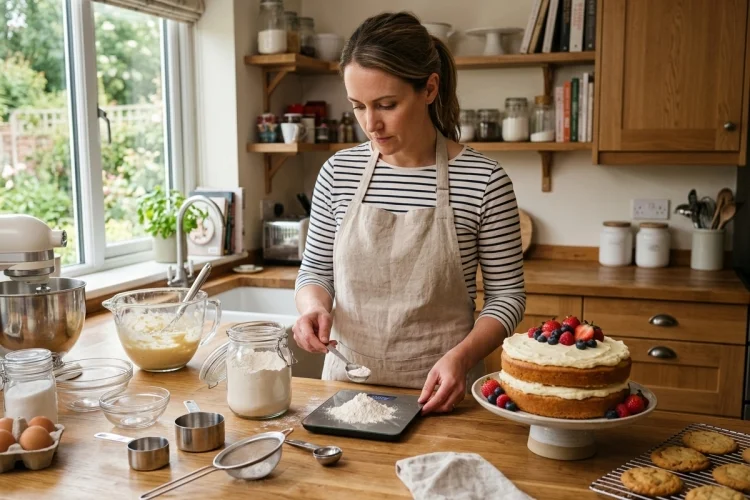
A digital kitchen scale improves accuracy and simplifies recipe scaling. Dividing 300 grams in half is more reliable than estimating half of an awkward cup measurement. Scales also make it easier to reproduce the quantities intended by the recipe developer.
To use one, place the mixing bowl on the scale and press the tare button to return the display to zero. Add the first ingredient, tare again, and continue with the next one.
Measuring spoons remain practical for very small amounts when a standard kitchen scale cannot register fractions of a gram. The goal is not to abandon every cup and spoon, but to use the most suitable tool for each ingredient.
7. Accuracy Also Includes Temperature and Pan Size
Correct ingredient quantities cannot rescue a bake from a badly inaccurate oven. When the actual temperature is lower than the display suggests, the outside may dry out while the center takes too long to set.
An independent oven thermometer can help confirm the real temperature. This is especially useful when cakes repeatedly take much longer than expected or cookies brown unevenly.
Ingredient temperature matters in some recipes too. Butter that is too cold may not cream properly with sugar, while butter that is excessively warm may become oily. Cold eggs can also disrupt a smoothly creamed cake mixture.
Use the pan size specified in the recipe. Pouring batter into a smaller, deeper pan changes how quickly heat reaches the center, while using a larger pan creates a thinner layer that may bake faster.
Finally, treat baking time as a guide rather than the only test. Begin checking near the lower end of the suggested range and look for physical signs such as set edges, a springy center, golden color, or a tester without wet batter.
Baking requires accurate measurements because every ingredient performs a structural job. Too much flour changes hydration, extra leavener affects the rise, and incorrect quantities of sugar, fat, eggs, or liquid can alter moisture, spread, and tenderness.
Use gram measurements whenever possible, level small spoonfuls carefully, and follow the requested pan size and ingredient temperatures. A digital scale and an independent oven thermometer can remove much of the guesswork.
Choose a familiar cookie, muffin, or cake recipe and prepare it using weights this week. Record the ingredients, pan, oven setting, and final result. That simple habit will help turn baking from a gamble into a dependable, repeatable skill.